
How to Reduce Machine Downtime in Manufacturing Plants in India
What Are the Best Ways to Prevent Unexpected Machine Downtime?
Causes, Proven Strategies & Best CMMS Software
Table of Contents
A single machine breakdown can stop an entire production line. Whether you’re operating an automotive plant in Chennai, a textile mill in Tirupur, a pharmaceutical facility in Hyderabad, or a food processing plant in Pune, unexpected equipment failures can lead to production delays, higher maintenance costs, missed deliveries, and reduced profitability.
The fastest way to reduce machine downtime is to combine preventive maintenance, real-time equipment monitoring, and an AI-powered Computerized Maintenance Management System (CMMS). This proactive approach helps manufacturers prevent unexpected breakdowns, improve equipment reliability, and maximize production uptime. Platforms like Fogwing CMMS make it easier to implement these strategies at scale.
However, many Indian manufacturers still rely on reactive maintenance, spreadsheets, or paper-based records. By the time a fault is identified, production has often already stopped. The good news is that most equipment failures show early warning signs and with the right maintenance strategy, they can be prevented before they disrupt production.
In This Guide, You'll Learn
- Why machine downtime is a growing challenge for manufacturers in India
- The most common causes of equipment failures
- 10 proven strategies to reduce machine downtime
- How AI-powered solutions like Fogwing CMMS support predictive maintenance
What Is Machine Downtime?
Machine downtime is the period when equipment is unavailable for production due to maintenance, inspections, repairs, or unexpected failures.
There are two types of machine downtime:
Planned Downtime
Scheduled maintenance, inspections, equipment upgrades, and calibration activities that help prevent larger failures and extend equipment life.
Unplanned Downtime
Unexpected equipment failures caused by mechanical, electrical, operational, or process-related issues. This type of downtime leads to:
- Production interruptions
- Emergency repairs
- Higher maintenance costs
- Missed production targets
- Customer dissatisfaction
Reducing unplanned downtime should be a priority for every manufacturing organization.
Why Is Machine Downtime a Growing Challenge for Manufacturing Plants in India?
Indian manufacturers are under constant pressure to increase productivity while controlling maintenance costs. Across industries such as automotive, textiles, pharmaceuticals, food processing, engineering, chemicals, and cement, even a few hours of unplanned downtime can disrupt production schedules, delay customer deliveries, and reduce profitability.
Machine downtime can lead to:
- Lost production hours
- Delayed customer deliveries
- Higher maintenance costs
- Reduced Overall Equipment Effectiveness (OEE)
- Shorter equipment lifespan
- Increased safety risks
The challenge isn’t always the equipment itself. Limited asset visibility, inconsistent maintenance practices, poor planning, and delayed decision-making often turn small issues into costly breakdowns.
As more manufacturers embrace Industry 4.0, maintenance is evolving from reactive repairs to proactive, data-driven asset management powered by AI, Industrial IoT, and CMMS software.
The average manufacturer experiences around 800 hours of equipment downtime each year, while unplanned downtime costs industrial manufacturers up to $50 billion annually

What Causes Machine Downtime in Manufacturing Plants?
Most machine failures are preventable. Understanding their root causes helps maintenance teams improve equipment reliability and reduce unexpected breakdowns.
| Cause | Business Impact | Recommended Solution |
|---|---|---|
|
Reactive maintenance |
Frequent breakdowns |
Preventive Maintenance |
|
Poor maintenance planning |
Missed servicing |
CMMS |
|
Limited equipment visibility |
Late fault detection |
Industrial IoT Monitoring |
|
Poor spare parts management |
Longer repair times |
Spare Parts Management |
|
Inconsistent maintenance procedures |
Human errors |
Digital Checklists |
|
Aging equipment |
Frequent failures |
Condition Monitoring |
|
Limited maintenance data |
Poor maintenance decisions |
Maintenance Analytics |
1. Reactive Maintenance
Waiting for equipment to fail results in emergency repairs, longer downtime, and higher maintenance costs. A preventive maintenance strategy helps identify and resolve issues before they become major failures.
2. Poor Maintenance Planning
Many manufacturers still rely on spreadsheets or paper-based maintenance records. This often leads to missed inspections, delayed servicing, and inconsistent maintenance activities.
3. Limited Equipment Visibility
Machines rarely fail without warning. Changes in vibration, temperature, pressure, or energy consumption often indicate developing problems. Without real-time monitoring, these issues are usually discovered only after production has stopped.
4. Poor Spare Parts Management
Even a minor component failure can keep production idle if the required spare part isn’t available. Maintaining critical spare parts inventory helps reduce repair time and improve maintenance efficiency.
5. Inconsistent Maintenance Procedures
Without standardized inspection checklists and maintenance procedures, technicians may perform the same task differently, increasing the risk of missed inspections, human errors, and recurring equipment failures.
6. Aging Equipment
Older assets require more frequent inspections, preventive maintenance, and condition monitoring. Without a structured maintenance program, aging equipment becomes a major contributor to unplanned downtime.
7. Limited Maintenance Data
Without centralized maintenance records, it’s difficult to identify recurring failures, analyze asset performance, or make informed maintenance decisions. A digital maintenance history enables better planning and continuous improvement.
10 Proven Strategies to Reduce Machine Downtime in Manufacturing Plants
Reducing machine downtime requires a combination of proactive maintenance, real-time visibility, and the right digital tools. The following strategies help manufacturers improve equipment reliability, reduce unexpected breakdowns, and maximize production uptime.
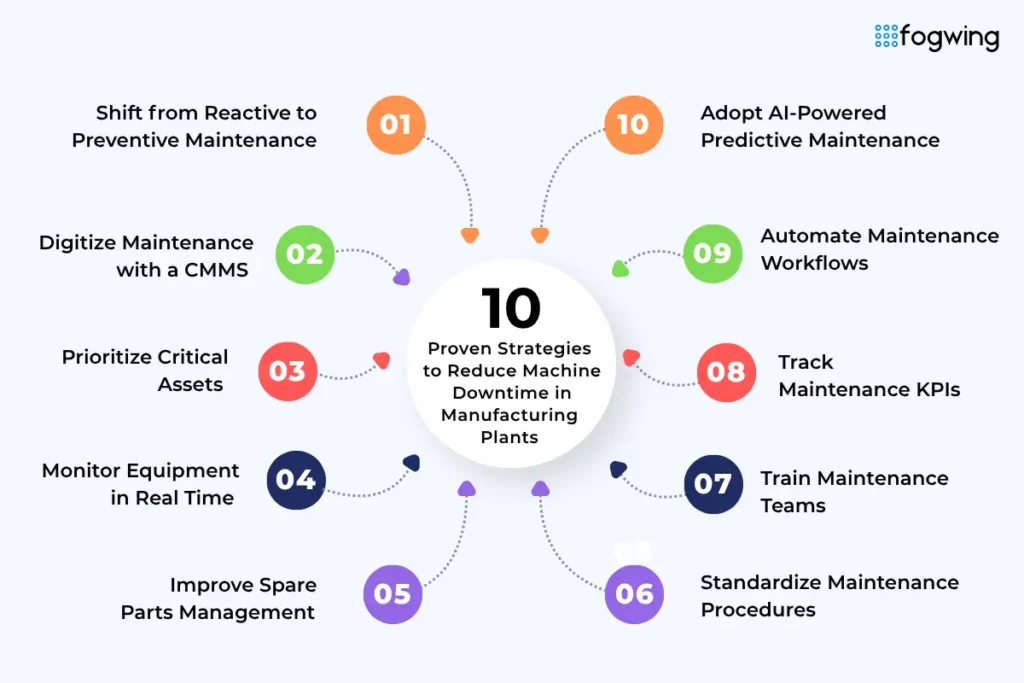
1. Shift from Reactive to Preventive Maintenance
Waiting for equipment to fail leads to costly downtime and emergency repairs. Instead, schedule maintenance based on running hours, production cycles, manufacturer recommendations, or asset criticality.
Benefits:
- Reduce unexpected breakdowns
- Extend equipment life
- Lower repair costs
- Improve equipment availability
An AI-powered CMMS automates preventive maintenance schedules, ensuring critical tasks are completed on time
2. Digitize Maintenance with a CMMS
Paper records and spreadsheets make maintenance management difficult. A CMMS centralizes maintenance activities, giving teams complete visibility into assets and work orders.
With a CMMS, you can:
- Schedule preventive maintenance
- Manage digital work orders
- Track maintenance history
- Monitor KPIs
- Manage spare parts inventory
3. Prioritize Critical Assets
Not every machine has the same impact on production. Prioritize maintenance based on asset criticality, downtime cost, safety risk, and failure history.
This ensures maintenance resources are focused on the equipment that matters most.
4. Monitor Equipment in Real Time
Industrial IoT sensors continuously monitor machine health, helping maintenance teams detect problems before they lead to failures.
Monitor parameters such as:
- Vibration
- Temperature
- Pressure
- Energy consumption
- Runtime hours
Early detection reduces downtime and improves equipment reliability.
5. Improve Spare Parts Management
A simple missing spare part can keep production idle for hours. Maintaining the right inventory helps reduce Mean Time to Repair (MTTR).
Best practices include:
- Maintain minimum stock levels
- Track parts by asset
- Automate low-stock alerts
- Review obsolete inventory regularly
6. Standardize Maintenance Procedures
Standardized maintenance procedures support Total Productive Maintenance (TPM) by ensuring every technician follows the exact same inspection and servicing process across shifts and locations. Using digital checklists eliminates variations and reduces human error during routine servicing
Common checklists include:
- Air compressors
- Pumps
- Boilers
- HVAC systems
- Conveyors
- Electrical panels
7. Train Maintenance Teams
Technology alone doesn’t reduce downtime, skilled technicians do.
Regular training in Root Cause Analysis (RCA), Reliability-Centered Maintenance (RCM), Predictive Maintenance, and CMMS best practices helps teams diagnose issues faster and improve maintenance quality.
8. Track Maintenance KPIs
You can’t improve what you don’t measure. Monitor key maintenance metrics to identify trends and optimize maintenance performance.
| KPI | Why Measure It? | Target |
|---|---|---|
|
MTBF |
Equipment reliability |
Higher is Better |
|
MTTR |
Repair efficiency |
Lower is Better |
|
OEE |
Overall production performance |
Higher is Better |
|
PM Compliance |
Preventive maintenance completion |
>90% |
|
Asset Availability |
Equipment uptime |
Maximize |
9. Automate Maintenance Workflows
Manual approvals and paperwork slow maintenance operations. Workflow automation keeps maintenance moving without delays.
Automate:
- Work order creation
- Preventive maintenance schedules
- Technician notifications
- Approvals
- Reports and dashboards
10. Adopt AI-Powered Predictive Maintenance
Predictive maintenance uses AI and Industrial IoT data to detect equipment issues before they become failures.
Key benefits:
- Predict component failures
- Identify high-risk assets
- Optimize maintenance schedules
- Extend equipment life
- Reduce unplanned downtime
As manufacturers embrace Industry 4.0, predictive maintenance is becoming a key strategy for improving equipment reliability.
Selecting the Right Maintenance Strategy for Your Plant
While basic digitisation software helps manage paperless work orders, modern manufacturing demands more. Manufacturers looking to eliminate the root causes of machine downtime should look for an integrated platform that combines core maintenance management with real-time Industrial IoT monitoring and AI-driven insights.
How Fogwing CMMS Helps Manufacturers Reduce Machine Downtime
Reducing machine downtime requires more than scheduling maintenance; it demands real-time visibility into asset health, automated workflows, and data-driven decision-making.
Fogwing CMMS combines preventive maintenance, AI-powered insights, and Industrial IoT capabilities in a single platform, helping manufacturers detect potential issues early, automate maintenance operations, and improve equipment reliability.
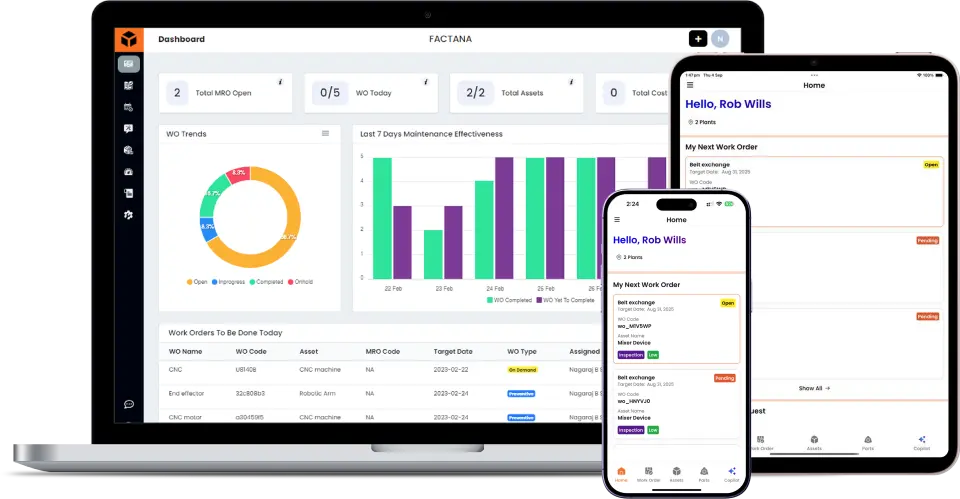
Key capabilities include:
- AI-powered maintenance recommendations
- Digital work order management
- QR code and barcode-based asset tracking
- Spare parts and inventory management
- Real-time Industrial IoT monitoring
- Mobile CMMS for field technicians
- Asset lifecycle management
- Maintenance dashboards and KPI reporting
- Multi-plant maintenance management
- Role-based workflows and approvals
Whether you’re operating an automotive plant in Chennai, a textile factory in Coimbatore, a pharmaceutical facility in Hyderabad, or a food processing plant in Gujarat, Fogwing CMMS helps maintenance teams reduce downtime through proactive maintenance planning and real-time operational visibility

Machine Downtime Reduction Checklist
Before implementing your maintenance improvement plan, use this checklist to evaluate your current maintenance program.
✔ Perform preventive maintenance on all critical assets.
✔ Monitor machine health using Industrial IoT sensors.
✔ Digitize maintenance operations using a CMMS.
✔ Maintain adequate inventory of critical spare parts.
✔ Standardize maintenance procedures with digital checklists.
✔ Measure MTBF, MTTR, OEE, and preventive maintenance compliance.
✔ Automate work orders and maintenance approvals.
✔ Train maintenance teams regularly.
✔ Review downtime reports every month.
✔ Use AI insights to identify high-risk equipment before failures occur.
Why Trust This Guide?
This guide combines established maintenance best practices with modern approaches to preventive maintenance, predictive maintenance, Industrial IoT, and AI-powered CMMS software. It is designed for Indian manufacturers across industries such as automotive, textiles, pharmaceuticals, food processing, engineering, chemicals, and cement.
The recommendations are based on proven maintenance methodologies, Industry 4.0 principles, and practical workflows used to improve equipment reliability and reduce machine downtime.
Conclusion
Reducing machine downtime starts with a proactive maintenance strategy. By combining preventive maintenance, predictive maintenance, Industrial IoT, and an AI-powered CMMS, manufacturers can improve equipment reliability, reduce maintenance costs, and maximize production uptime.
As Indian manufacturers continue adopting Industry 4.0, digital maintenance is becoming a competitive advantage rather than an operational choice. For organizations looking to combine AI, predictive maintenance, asset management, and Industrial IoT in a single platform, Fogwing CMMS provides the tools needed to build a smarter, more reliable maintenance operation.
FAQs
1. How can manufacturing plants reduce machine downtime?
Manufacturers can reduce machine downtime through preventive maintenance, real-time equipment monitoring, spare parts management, standardized maintenance procedures, and an AI-powered CMMS.
2. What is the biggest cause of machine downtime?
The most common causes are reactive maintenance, poor maintenance planning, limited equipment visibility, inadequate spare parts management, and inconsistent maintenance practices.
3. How does CMMS software reduce machine downtime?
A CMMS helps reduce downtime by automating preventive maintenance, managing work orders, tracking maintenance history, monitoring asset performance, and improving maintenance planning.
4. What industries benefit from reducing machine downtime?
Industries such as automotive, food processing, pharmaceuticals, textiles, chemicals, engineering, cement, steel, and FMCG benefit from improved equipment reliability and higher production uptime.
5. Which CMMS software is best for reducing machine downtime in India?
The right CMMS depends on your operational goals. Manufacturing plants looking to significantly reduce downtime, automate preventive tasks, and leverage AI with Industrial IoT monitoring should evaluate end-to-end platforms like Fogwing CMMS that offer both asset management and real-time intelligence.