Introduction: What is Industrial Cloud?
If you’ve ever wondered what Industrial Cloud is and why it matters for modern manufacturing, you’re not alone. Industrial Cloud is a specialized cloud computing environment built for factories, plants, and industrial enterprises. Unlike generic cloud services, it brings together IoT data, asset management, production monitoring, and AI analytics — enabling smarter, more connected, and predictive operations.
At its core, Industrial Cloud is the backbone of Industry 4.0. It connects machines, sensors, and assets to a centralized platform where data is stored, processed, and transformed into actionable insights. The result is improved equipment uptime, better production visibility, and a data-driven approach to decision-making.
Think of Industrial Cloud as the bridge between Operational Technology (OT) on the shop floor and Information Technology (IT) in the enterprise.
In general, Cloud Computing is a vast network of computing servers available around the globe, together operating as a single ecosystem. Cloud computing services have gone a step ahead and provide business support functions in various industry domains. Every industry is in the process to leverage cloud computing services in recent times.
Key Layers of Industrial Cloud
When asking what is Industrial Cloud, it helps to understand its architecture:
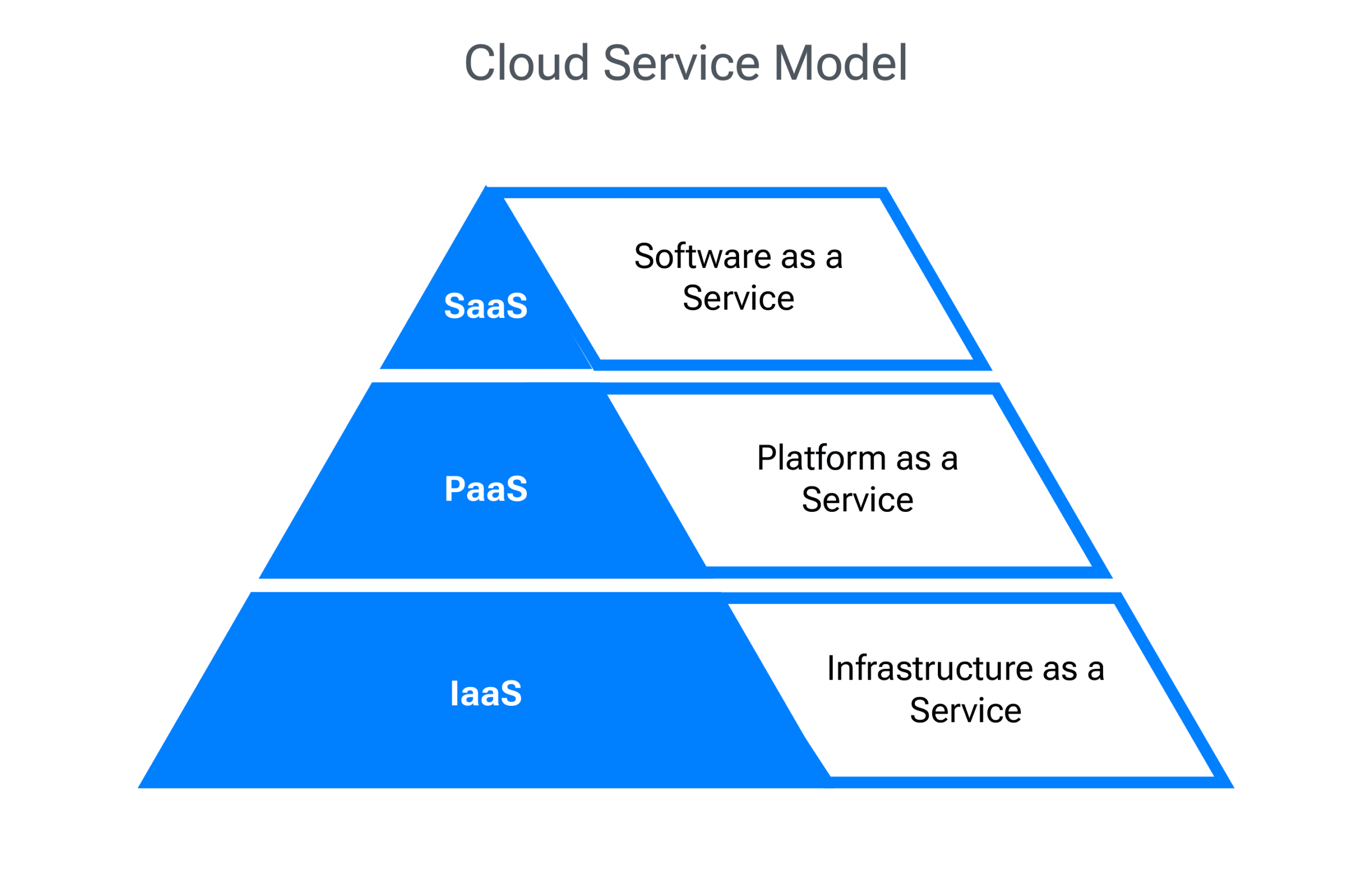
Infrastructure as a Service (IaaS): Compute, storage, and networking for industrial workloads.
Platform as a Service (PaaS): Industrial IoT connectivity, device management, data pipelines, and AI model deployment.
Software as a Service (SaaS): Ready-to-use industrial apps like maintenance management, production scheduling, and quality inspection.
Infrastructure as a Service
Infrastructure as a Service (IaaS) is a foundational layer of cloud computing service. It is a basic building block of computing services that provide access to computing features such as virtual servers, operating systems, networks, and data storage. IaaS is suitable for small to large companies/organizations due to its cost-effective IT infrastructure hosting solutions. IaaS is offered as a private, public, or hybrid infrastructure. Amazon Web Services (AWS), Microsoft Azure, and Google Compute Engine (GCE) are a few examples of IaaS cloud service providers.
Platform as a Service
Platform as a Service known as PaaS, provides an on-demand environment to develop, test, deliver, and manage software applications. It manages the underlying application-specific servers, network, storage, and databases, while organizations focus on managing and deploying applications.
Software as a Service
Software as a Service caters to diverse business functions, such as business analytics, automation, customer management, etc. SaaS also offers user-friendly, reducing the need for IT specialists, strenuous set-up, and maintenance. This is the most common cloud computing service, in which people often use SaaS apps, like Gmail and Slack.
Fogwing’s approach combines both horizontal (platform) and vertical (application) elements, giving users both a base to build and ready-to-use solutions to accelerate.
Why Industrial Cloud Matters for IIoT & Industry 4.0
Industrial Cloud is a core enabler for IIoT and Industry 4.0 because it:
- Connects the physical to the digital — ingesting sensor, machine, and operational data.
- Unifies siloed data — from different plants, systems, formats — in a central, normalized environment.
- Delivers real-time analytics and insights — enabling predictive maintenance, anomaly detection, and process optimization.
- Supports scale and agility — systems evolve, scale, or shift across locations without rip-and-replace.
- Leverages AI / ML models — continuous learning, root cause analysis, and autonomous decision-making become possible.
Industrial Cloud bridges OT (operational technology) and IT, giving organizations the connective tissue to evolve from reactive to proactive and, ultimately, prescriptive operations.
Industries across the globe increasingly rely on cloud computing services to manage their Industrial IoT technology. The Industrial Internet of Things is the connection of industrial machines over a network for communications. It’s also referred to as the Industrial Internet. The Industrial IoT cloud enables to control machines and manufacturing processes remotely. Cloud computing provides a secure platform for Industrial data sharing between organizations. Many businesses use IIoT to collect machines’ data and store it in cloud storage for later processing. Industrial Cloud computing offers different types of application services which can be used by businesses according to their needs.
Key Benefits for Industrial Organizations
When industrial firms adopt an Industrial Cloud strategy — particularly one tied to smart applications — they realize several strategic benefits:
- Cost Efficiency & OpEx Model: Avoid heavy upfront infrastructure investment; shift to subscription or consumption-based pricing.
- Security & Governance: Centralized data controls, role-based access, and audit trails help ensure compliance across sites.
- Scalability & Flexibility: Add new sites, machines, or users with minimal friction.
- Seamless Upgrades & Innovation: Platform upgrades, feature rollouts, and optimizations can be delivered transparently.
- Real-time Insights & Predictive Power: Access to live dashboards and predictive models boosts responsiveness and planning.
- Resilience & Continuity: Cloud-native systems support backup, failover, and disaster recovery across geographies.
- Interoperability & Ecosystem Integration: APIs and connectors facilitate integration with ERP, MES, SCADA, and more.
Together, these benefits help industrial firms move toward a more intelligent, responsive, and autonomous operational state.
Industries Response to Industrial Cloud
Different Industries or Business enterprises across the globe are leveraging cloud computing for meeting their various needs and reinventing business processes to align with current market trends efficiently. Cloud computing has changed the way many sectors operate, accelerating the creation and ensuring businesses’ survival. The global cloud computing industry is predicted to increase at a 16.3 percent compound annual growth rate (CAGR) from USD 445.3 billion in 2021 to USD 947.3 billion in 2026, indicating mass adoption of cloud computing by corporate giants to small-scale start-ups. (ReportLinker 2021). But have you wondered which industry is the biggest user of cloud computing? It is undoubtedly the Automotive Industry.
Fogwing Industrial Cloud
Fogwing’s current portfolio reflects our vision of an integrated, scalable, and intelligence-driven industrial cloud. Below is how our foundational layers and product offerings combine to deliver value.
Fogwing Industrial Cloud offers the following cloud services as specialized :
- Fogwing IIoT Platform (Foundation Layer)
- Fogwing Edge & AI at the Edge
- Industrial AI & Copilot
- Industrial SaaS Applications (Vertical Solutions)
- Foundation Operations & Governance
1. Fogwing IIoT Platform (Foundation Layer)
At the core is the Fogwing Industrial IoT Platform: a no-code / low-code device management and connectivity fabric. It enables:
- Seamless onboarding and management of devices, gateways, and sensors
- Real-time streaming and time-series ingestion
- Edge-cloud orchestration and local logic execution
- APIs, event triggers, and integration connectors
This foundational layer abstracts away connectivity complexity and data plumbing, letting you focus on application logic and insights.
2. Fogwing Edge & AI at the Edge
To support low-latency decisions and offline scenarios, Fogwing Edge enables deploying models, rules, and analytics close to machines. This ensures:
- Near-instant response to anomalies
- Bandwidth-efficient operation (sending only distilled insights to the cloud)
- Continuity when connectivity is intermittent
3. Industrial AI & Copilot
Fogwing now embeds Agentic AI / Copilot capabilities throughout the stack. This layer allows users to:
- Receive natural language insight summaries and alerts
- Ask questions of their operational dataset (“Which machine’s vibration is trending upward?”)
- Auto generate maintenance work orders or anomaly investigations
- Guide domain experts through root-cause workflows
By weaving AI into analytics, Fogwing helps users unlock insight, not just data.
4. Industrial Applications (SaaS Solutions)
On top of this foundation, Fogwing provides a mature suite of industrial SaaS apps that address common operational domains:
- Fogwing CMMS – Maintenance & CMMS / EAM (Fogwing Maintenance / Asset Management): Plan, schedule, and execute preventive, predictive, corrective work across assets
- Fogwing Matrix – Smart Production / Production Management with Real-time visibility of shop-floor KPIs (OEE, cycle time, throughput, quality)
- Fogwing Vision – Quality & Visual Inspection uses embedded computer vision and defect detection to automate QA and compliance
- Fogwing Tools – Tools & Calibration Management: Track tools usage, calibration cycles, refurbishment, and traceability
- Fogwing Eco – Environmental monitoring solution with focus on air pollution, employee safety and incident prevention.
These applications share the same data fabric, security, and logic layers — reducing silos and boosting interoperability.
5. Foundation Operations & Governance
Supporting all layers are capabilities around:
- Role-based access control (RBAC), security, and audit logs
- Multi-tenant or site-level isolation
- Model governance and lifecycle management
- Data retention, archival, and compliance
- Analytics templates, KPI frameworks, and domain accelerators
How Fogwing Aligns with Industrial Needs
Modular Stack with Composable Flexibility
Customers no longer need to deploy or rip-and-replace monolithic suites. With Fogwing, you can start with the IIoT Platform + one use-case (e.g. condition monitoring) and expand stepwise into maintenance, production, or AI capabilities.
Intelligence Embedded, Not Bolt-On
Rather than treating AI as an afterthought, Fogwing’s AI Copilot is woven through device, edge, analytics, and SaaS layers — enabling proactive, conversational, and actionable insights.
Edge-Cloud Continuum
Fogwing supports hybrid architectures smoothly: you can run analytics at the edge, centralize data in cloud, and flow logic between layers — ensuring responsiveness and resilience.
Use-Case First, Not Technology
Fogwing’s focus is solving real industrial challenges — whether predictive maintenance, tool calibration, quality assurance, or production bottlenecks — rather than pushing generic infrastructure.
Implementation Roadmap & Best Practices
- Define prioritized use-cases — start with 1–2 high-impact domains (e.g. vibration-based maintenance, quality inspection)
- Onboard assets and connect devices — use the IIoT Platform to bring assets, sensors, and machines online
- Deploy edge logic where needed — push detection, alerts, or rule engines closer to machines
- Build or customize SaaS apps — configure workflows, dashboards, or AI models in the applications
- Train users and embed governance — align roles, access, and analytics ownership
- Iterate, scale, and expand — expand to more sites, domains, and models
- Continuously measure ROI & value — track metrics (e.g. downtime reduction, maintenance costs, quality yield)
This incremental approach ensures value delivery early, mitigates risk, and helps organizational buy-in.
Conclusion
Industrial Cloud is no longer an abstract ideal — it’s evolving into the backbone of modern, intelligent operations. With Fogwing’s enriched foundation (IIoT, Edge, AI Copilot) and domain SaaS offerings (Maintenance, MES, Quality, Tools), organizations gain a unified, scalable, and future-proof platform to accelerate digital transformation.